

From Exclusion to (Near) Equality
What New Olympic Data Reveals
Short essay by Gijsbert Oonk
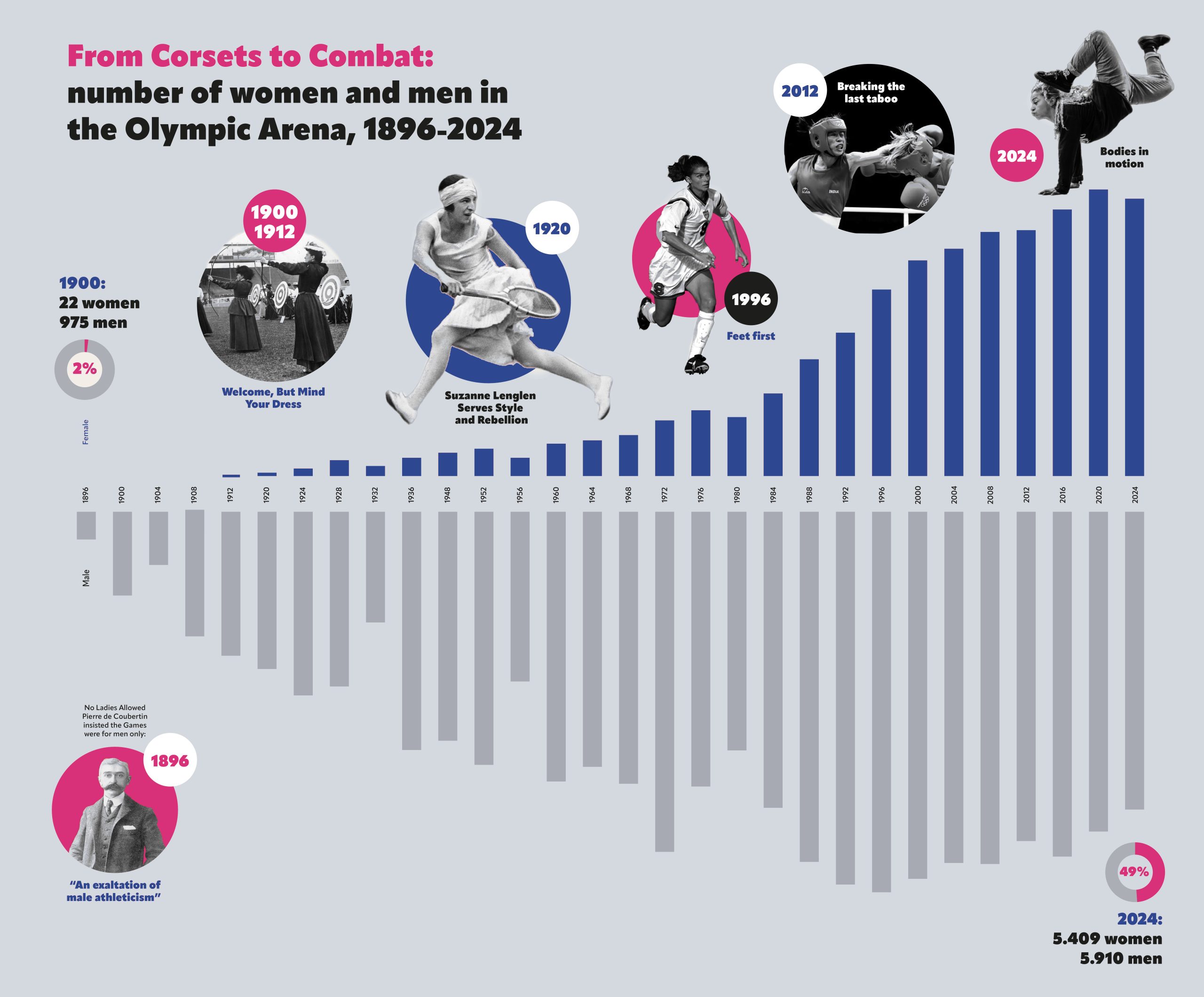
At the 2024 Summer Olympics, headlines celebrated a historic milestone: for the first time, the number of women competing almost matched that of men. It is an important moment, but it raises a harder question: why did it take over a century to get here?
Olympic Athletes & Global Inequality: A Historical Dataset (1896–2024), Olympic Athletes & Global Inequality: A Historical Dataset (1896–2024), was designed to help answer such questions. By compiling athlete-level data across the entire modern Olympic period, it allows us to trace patterns of inclusion and exclusion over time, across countries, and within specific sports. Rather than treating sport as an isolated domain, it approaches the Olympics as a global arena where wider gender, political, and cultural inequalities are played out.
Games designed to exclude
The first visualisation emerging from this dataset shows the gradual inclusion of women across Olympic sports. What it reveals is not a linear story of progress, but a long and uneven process shaped by institutional resistance and cultural norms.
In 1896, women were entirely absent, by design. Founder Pierre de Coubertin and the early Olympic movement explicitly envisioned the Games as a male domain, inspired by their interpretation of ancient Greek tradition. This exclusion was not only ideological; it was reinforced by contemporary medical and scientific discourse. Religious institutions, doctors and educators warned that strenuous physical activity could damage women’s reproductive health, framing athletic ambition as fundamentally “unfeminine.”
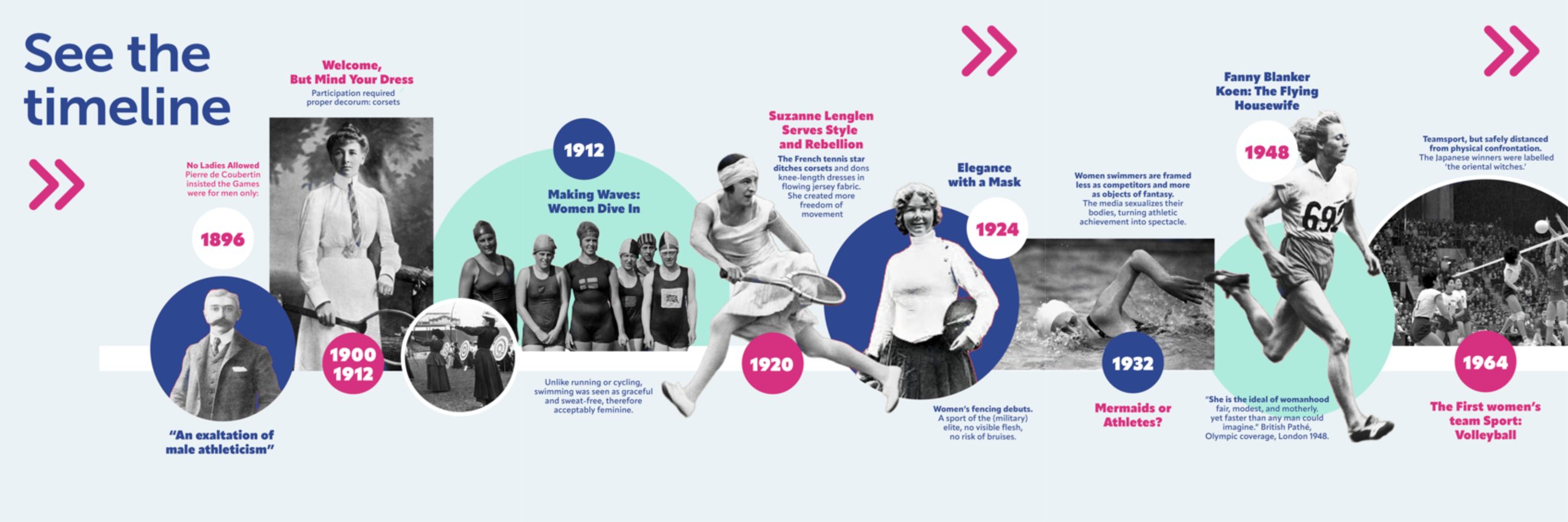
When women were gradually admitted, it was under tightly controlled conditions. Early participation was limited to sports such as tennis and archery, disciplines associated with elite femininity and minimal physical contact. Even then, strict dress codes ensured that women’s participation did not challenge prevailing gender norms.
Strong women, uneasy crowds
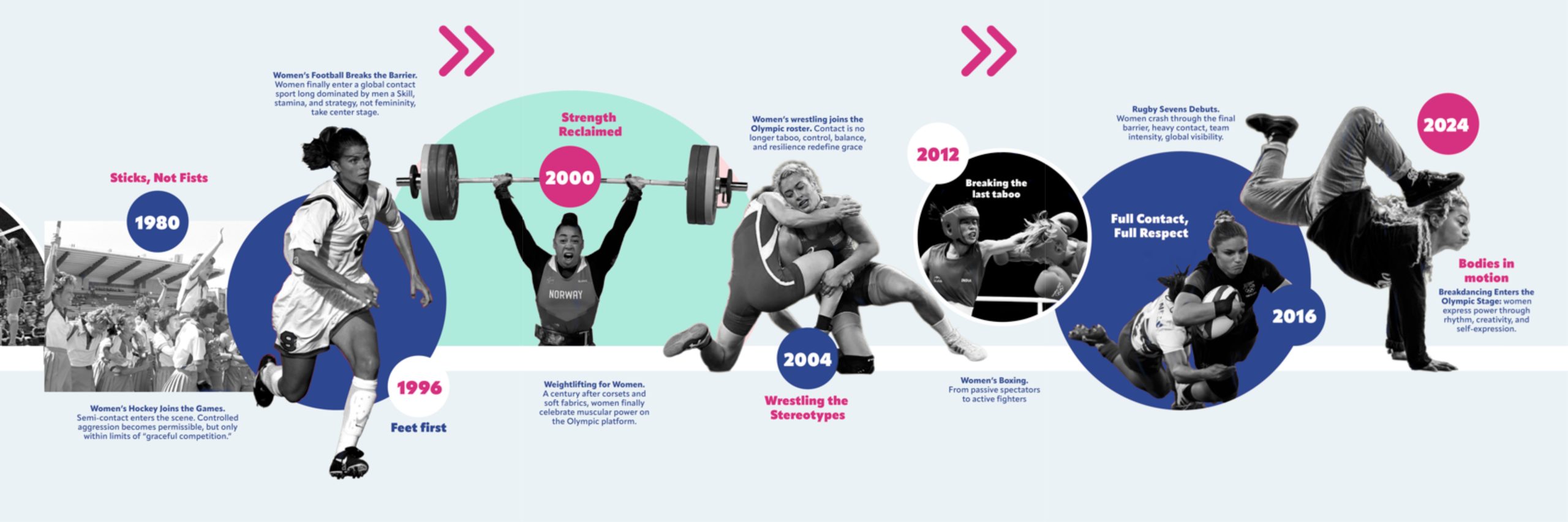
The real shift came much later, and it unfolded unevenly. Women’s team sports only began to enter the Olympic programme in 1964, when volleyball, a relatively low-contact sport, marked the start of a broader yet cautious expansion. Hockey followed, then football, and eventually rugby. Each addition reflected a negotiation over what kinds of physicality were still considered acceptable for women. Weightlifting and boxing came last. Since these sports were associated with visible strength, building muscularity, and combat, their inclusion was more than a simple expansion of the programme. It marked the gradual breakdown of long-standing assumptions about women’s bodies and capabilities.
The dataset makes clear that inclusion was never simply about fairness or equal opportunity. It was shaped by shifting institutional logic, evolving ideas in science and medicine, and persistent activism. The exclusion of women from the marathon, for example, was justified well into the late twentieth century by medical claims that women were biologically unsuited for long-distance running. The late inclusion of boxing and weightlifting similarly reflects long-held anxieties about women displaying strength and physical dominance, traits historically coded as masculine.
Athletes rewrite the rules of the game
These boundaries were not only imposed, they were contested. Women athletes and organisations actively challenged exclusion. The introduction of women’s athletics in 1928 followed sustained lobbying, while later breakthroughs, from long-distance running to football and boxing, were driven by athletes who competed, protested, and organized despite institutional resistance.
One striking example is Nawal El Moutawakel. When she won the 400 metres hurdles at the 1984 Los Angeles Games, she became the first Muslim woman to claim Olympic gold. The significance of that moment reached far beyond the track. Her victory challenged assumptions about who could represent athletic excellence on the global stage, especially for women from the Global South. El Moutawakel did not remain only a symbolic figure. She moved into the International Olympic Committee, where she actively advocated for expanding women's participation in regions that had long been underrepresented in the Olympic movement. Her path from athlete to policymaker shows how representation can become institutional influence.
Gender parity is not the finish line
The 2024 milestone is not the endpoint of a natural progression. It is the outcome of more than a century of conflict, compromise, and change. For that reason, this first visualisation is more than a descriptive timeline. It is an analytical tool that exposes the layered processes through which global inequalities are constructed and, and at times dismantled.
The next step is to push the analysis further by connecting gender inclusion to inequalities in nationality, migration, and access to resources. Because if the Olympics tell us anything, it is this: who gets to compete has never been just about sport.
Dataset
Olympic Athletes & Global Inequality: A Historical Dataset (1896–2024), supported by the Erasmus Data Collaboratory, is freely available. Researchers, students and journalists are welcome to use and build on it. If you want to read more about the collaboration, see the EDC Story Card: Olympic Dream.
This essay is part of a broader effort to share inspiring data stories from researchers and/or practitioners. If you would like to collaborate on a story, please reach out to Marta Stachowiak-de Wit, Head of Marketing and Communications, via mc.ecda@eur.nl.