

Executive Expert Session — Reimagining Your Business: Data & AI in the Boardroom
We look back on a successful Executive Expert Session Reimagining your business – Data & AI in the Boardroom, which took place on September 15. A teaser with relevant insights, carefully tailored to the needs of executives, board members, supervisory directors, and leaders in digital transformation. What incredible energy and inspiring feedback afterwards. Thank you very much for that.
What are the key takeaways from this Executive Expert Session?
AI: Technology and Leadership
AI is not just about technology; it is, above all, about leadership. Boards must now take the lead by placing AI on the strategic agenda, making data central, fostering experimentation, and purposefully transforming their organizations with a sense of urgency. It is crucial to start from the concrete problems you want to solve, not from the technology itself.
Top 11 insights from the session with concrete actions for leaders
1AI is strategic, not just technical
AI is no longer the exclusive responsibility of the CTO, CDO, or IT department. It belongs in the boardroom and requires vision, oversight, and courage.
2Start small and start now
Waiting for perfect conditions is a trap. Small experiments and MVPs are the foundation of lasting transformation. Embrace an iterative mindset with experimentation and continuous learning, including from “failures”, at the centre.
3Operational impact often outweighs flashy front-end AI
The greatest value of AI often lies in operational efficiency, not just in flashy customer-facing tools like AI chatbots. A smart balance is needed. Too often, the focus is on customer-facing efficiency gains, while at least as much (often more) value can be found in back-end efficiency and customer-facing effectiveness.
4Data is the foundation and your differentiator, not AI tools
Without clean, reliable, and accessible data, AI fails. Everyone has access to the same AI tools. Your only true competitive advantage lies in the quality and uniqueness of your data. ROI comes not from more tech investments, but from better use of existing data and combining different types of data.
5Legacy systems hold you back
Clinging to outdated infrastructure limits agility and innovation potential. Modernization is not optional; it’s a necessity.
6AI rewards speed and boldness
AI rewards decisiveness. Those who move too slowly fall behind. Make sure your organization acquires the right AI skills and attracts AI talent. Every employee needs at least a basic level of AI literacy (ensure access to professional programs).
7Focus; don’t fragment
Scattered AI efforts reduce impact. Targeted choices drive progress.
8AI is never the starting point
Gain focus by working in a data-driven way and asking: what problem do I want to solve, which decisions can be supported by data? This may uncover both opportunities and challenges, and provide momentum for transformation and innovation. This is your starting point for successful AI implementation.
9Balance conflicting priorities like innovation and governance
Leadership today means balancing opposing priorities such as fast innovation and strong governance. The same applies to AI: is the human or the AI in control? At the same time, AI offers organizations the ability to connect opposites, such as automation and human interaction (high tech vs. high touch). For example, AI can handle routine, data-intensive tasks, allowing people to focus on empathy, creativity, and trust.
10The potential of AI lies in redefining value creation
The power of AI lies in reshaping business models, processes, and value creation.
11Build a data-centric operating model
Sustaining the added value of data and AI for your organization lies in your operating model.
Data, AI, and culture go hand in hand:
Key learnings (video)
You can also revisit the avatar of Fons Trompenaars, who summarizes the key learnings from the panel discussion. Click here to watch the video.
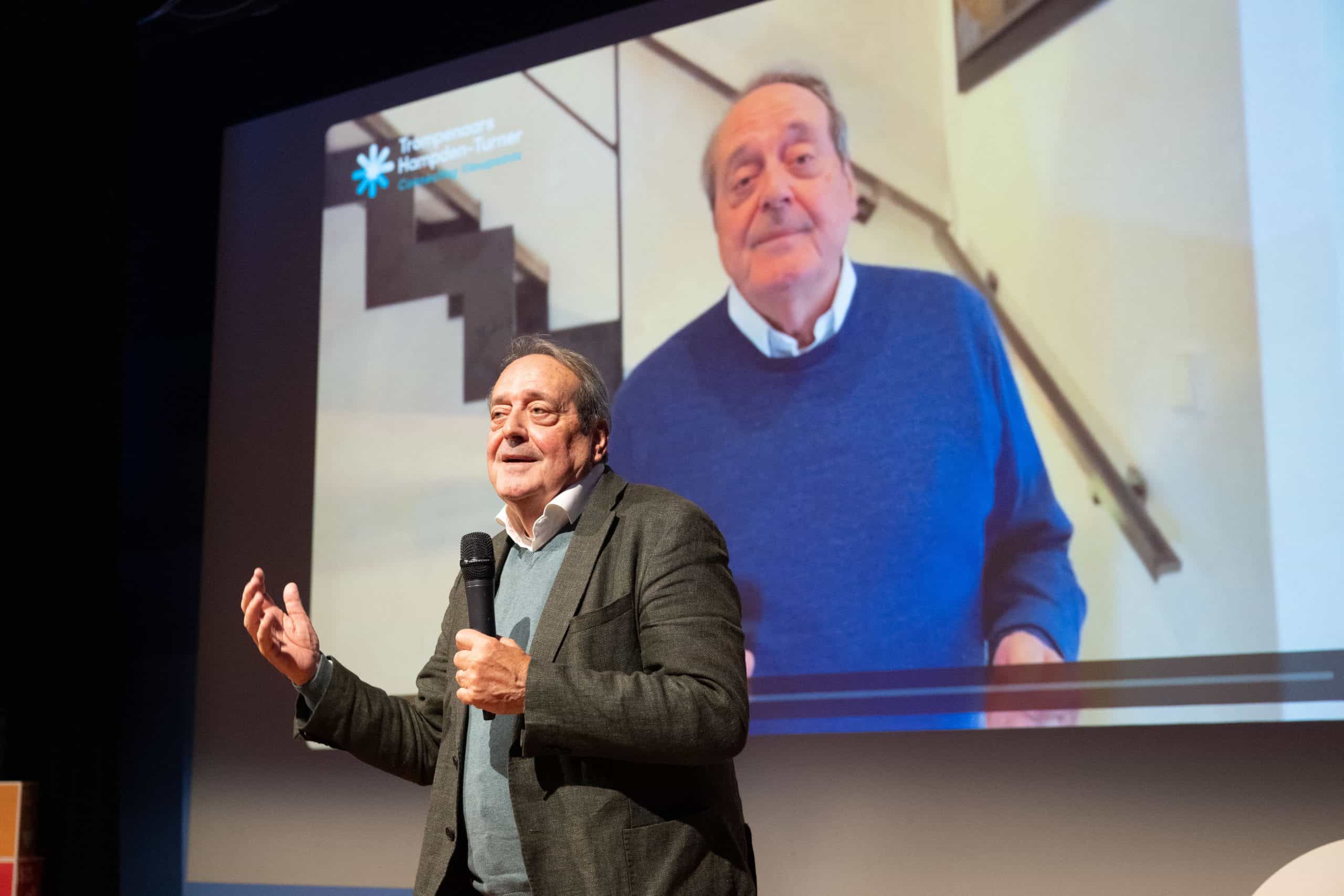
What did we focus on during the session?
During the expert session, we went beyond technology and focused together on: vision, strategy, and AI use cases, hybrid intelligence and AI as a work partner, human trust and conscious adoption with insight into AI models, AI factories and innovation power, and data-centricity as a source of digital transformation.
Many thanks to all contributing experts
Fons Trompenaars
Bestselling author, Thinkers50, digital visionary
Cynthia Liem
Associate Professor, TU Delft
Koen van den Berg
AI Factory Lead EMEA, NVIDIA
Ken van Ierlant
CEO, Mr. Data, author Data Value Creation
Marguerite Soeteman-Reijnen
Supervisory Board Member Siemens Netherlands and MN, Chair Advisory Board SER Top Women, Former Chair Aon Netherlands Holding
Daniel Gebler
Founder & CTO, Picnic Technologies
Annemarie Peijnenborgh
Head of Business Intelligence & Data, JBT Marel
Robert Rooderkerk
Associate Professor of Operations Management, Rotterdam School of Management, Erasmus University
Dénelise L’Ecluse
Former MD BSI Europe, Chair @AI4All
And of course, a heartfelt thank you to all attending executives and leaders. Together, we create this unique setting, where you can openly engage with peers from diverse industries, dive deeper into relevant strategic choices around AI and digital transformation, and share insights that can be directly applied within your own organization.
Wil je een persoonlijk gesprek inplannen? Stuur hiervoor een e-mail naar Marta Stachowiak-de Wit, Head of Marketing, via dataleadership@eur.nl.