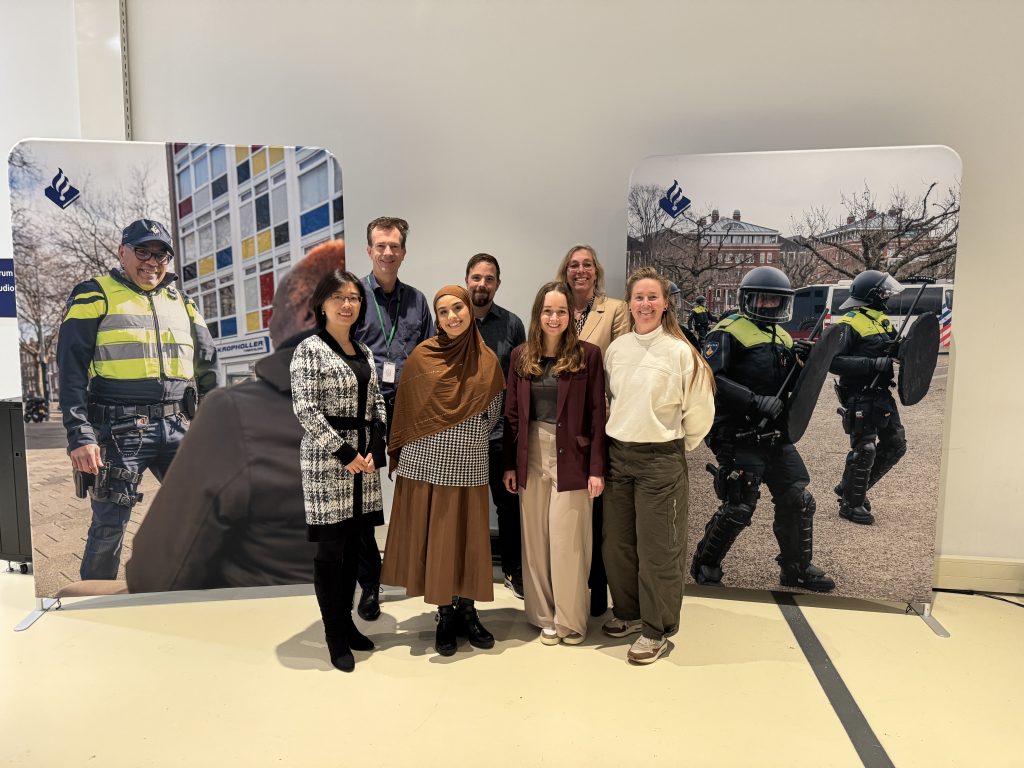

De portefeuille digitale transformatie van de Netherlands Police and the Erasmus Centre for Data Analytics (ECDA) at Erasmus University Rotterdam are launching a five-year collaboration, starting with a research project on the use of extended reality (XR) technologies—such as virtual reality (VR)—in police training. The project, which officially begins on 1 December 2025, focuses on how VR can contribute to more effective learning, mental resilience, and improved operational performance among police officers. The research is part of the police’s ambition to carefully and legitimately integrate XR technology into learning & development, daily operations, and strengthening its connection with society by 2030.
Research objectives
Prof. Dr. Yvonne van Everdingen and Prof. Dr. Ting Li, both affiliated with the Rotterdam School of Management, Erasmus University, will supervise the research. The focus lies on the following central themes:
- Effectiveness of VR training:How does VR compare to traditional training methods in terms of knowledge retention, decision-making, and behavioral skills?
- Mental resillience: What role does VR play in stress tolerance, emotional regulation, and psychological safety among officers?
- Design and scalabilityWhich didactic and technological design elements make VR training most effective and widely applicable?
- Information and organisation: What economic, legal, and organisational conditions are necessary for large-scale adoption of XR within the police?
The research will be carried out by a dedicated PhD researcher, who—alongside supervision from EUR professors and ECDA experts—will also be supported by Dr. Tim Theeboom, who works within the Digital Transformation portfolio of the Netherlands Police. ECDA will act as project driver, providing overall direction and coordination, while the Immersive Xperience lab team van ECDA adviseert bij het veldonderzoek met diverse XR-toepassingen en het delen van de resultaten richting interne en externe stakeholders.
Collaboration between science and practice for positive social impact
The project aligns seamlessly with Erasmus University Rotterdam’s Strategy 2030 to be an engaged university, one that is deeply connected to society and contributes to actionable scientific insights through research and co-creation within sustainable partnerships.
According to prof. dr. Ting Li, director of the Immersive AI Lab within Convergence and of the Digital Business expert practice at ECDA, the value lies especially in the integrated approach: “By combining insights from psychology, behavioural research, and human-computer interaction, we produce knowledge that is not only theoretically innovative but also directly applicable within the police organisation.”
Erasmus University Rotterdam also aims to promote the responsible use of technologies. Through this collaboration, ECDA and the police are committed to the responsible, human-centered, and conscious development and deployment of XR, as well as to gaining insights into what is required to scale this responsibly.
“This project brings science and practice together,” says prof. dr. Yvonne van Everdingendirector of the Immersive Tech expert practice at ECDA. “We are not only examining whether XR works, but also how we can deploy it safely, at scale, and cost-effectively for police training.”
Digital Transformation
A rapidly changing society calls for digital transformation—a movement within the police that ensures we can keep pace with (digital) developments and align with global digitalisation. This movement ensures that we embrace new (digital) innovations, thereby unlocking a world of possibilities. We do this by using digital tools to make police work more effective and efficient, in close coordination and collaboration with partners throughout the chain.
Dr. Tim TheeboomXR project leader within the Digital Transformation portfolio of the Netherlands Police, emphasizes: “With this research, we are taking an important step toward a future in which XR technology can be deployed even more effectively, helping colleagues to (continue to) develop professionally and to perform their work effectively and safely.”
Marie Kegeleersmanager of the Immersive Xperience Lab: “This collaboration enables impactful use of XR within the police, but it is also a valuable opportunity to demonstrate how this technology can be deployed effectively and meaningfully for society.”
About ECDA
The Erasmus Centre for Data Analytics (ECDA) connects academia, industry, and government around the impact of data, artificial intelligence, digitalisation, and immersive technology. As a leading expertise center of Erasmus University Rotterdam, we foster collaboration and innovation that create social and economic value.
Press contact
- Erasmus Centre for Data Analytics (ECDA), mc.ecda@eur.nl
Marta Stachowiak-de Wit, Head of Marketing and Communications - Nederlandse Politie, mediadesk.kl@politie.nl
Karin Donk, Strategic Spokesperson Police Staff Leadership – Digital Transformation